조인 = join은 두 개 이상의 테이블을 묶어 하나의 결과 테이블을 생성함
예제)
cookDB
userTBL = 회원정보
buyTBL = 구매 정보
한 회원이 여러 개의 구매 기록을 가짐
userTBL - buyTBL을 join으로 엮어서 구매내역 조회
내부 조인 inner join
일반적인 조인을 지칭함, 가장 많이 사용되는 조인 방식
두 테이블의 내부 조인
select 열 from 첫테이블 join 두번째테이블 on 조인될조건 where 검색조건
KYM이라는 아이디를 가진 회원이 구매한 물건을 발송하려면?
use cookdb;

select * from buytbl as b join usertbl as u on b.userID = u.userID where b.userID = 'KYM';
내부 조인의 작동 과정
b.userID에서 회원 아이디 추출
u.userID에서 동인한 값 추출
아이디 기준으로 두 테이블을 결합 = 조인
조인으로 속성을 찾을시 '테이블이름.테이블속성이름'을 맞춰 주어야 한다
use cookdb;

select userID, userName, prodName, addr, concat(mobile1, mobile2) as '연락처' from buytbl as b join usertbl as u on b.userID = u.userID;
만약 없이 조회를 하면

오류로 처리가 된다
use cookdb;

select b.userID, u.userName, b.prodName, u.addr, concat(u.mobile1, u.mobile2) as '연락처' from buytbl as b join usertbl as u on b.userID = u.userID;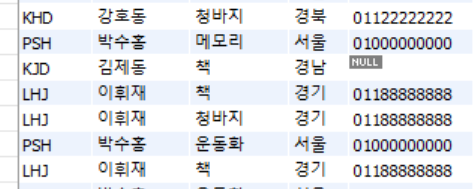
잘 나오는 것을 확인할 수 있다
Q. 이때 join을 A, B로 거는것과 B, A로 거는 것은 결과가 같은가?
A. 결과는 같다
오른쪽 왼쪽 규칙 같은것은 없다
inner의 경우는 차이가 없지만
outer의 경우는 차이가 난다
use cookdb;

select distinct u.userID, u.userName, u.addr from usertbl as u join buytbl as b
on u.userID = b.userID order by u.userID;

select u.userID, u.userName, u.addr
from usertbl as u
where exists (
  select * from buytbl as b
  where b.userID = u.userID
);
같은 결과를 내지만 다르게 표현이 가능하다
예제 문제)
강의와 교수 테이블이 있을시 이를 연결하시오
use schooldb;

select c.course_id, c.title, p.name from course as c join professor as p on c.prof_id = p.prof_id;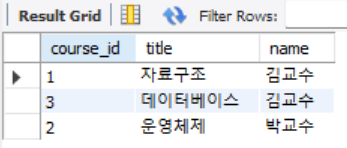
시험에 나온다면?
prof_id = 1인 사람만 조회
혹은 이름으로 조회
use schooldb;

select e.enroll_id, s.name, c.title
from enroll e
join course c
on e.course_id = c.course_id
join student s
on e.student_id = s.student_id;
3중 조인도 같은 형식으로 사용할 수 있다
외부 조인 outer join
조인 조건을 만족하지 않는 행까지 포함하여 출력하는 조인
use cookdb;

select u.userID, u.userName, b.prodName, u.addr, concat(u.mobile1, u.mobile2) as '연락처'
	from usertbl u
		left outer join buytbl b
			on u.userID = b.userID
		order by u.userID;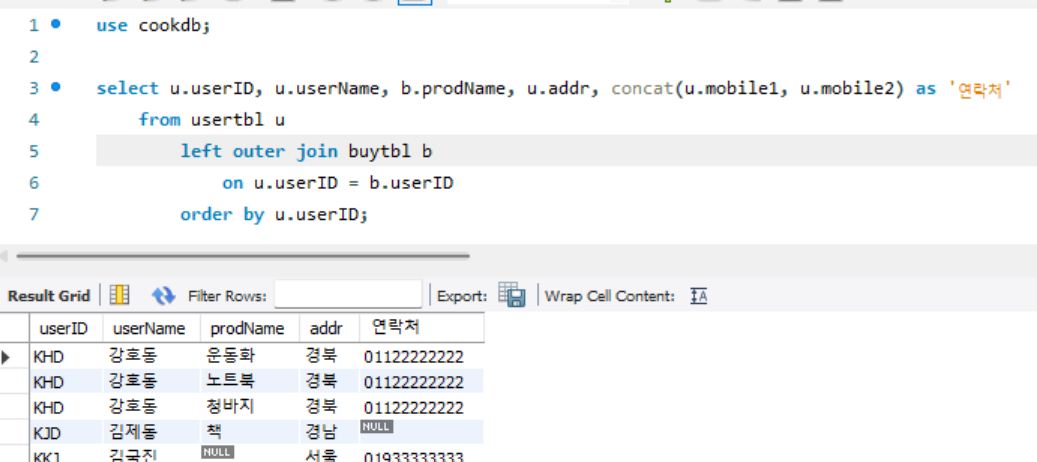
구매가 없는 사람도 조회가 된다
use cookdb;

select u.userID, u.userName, b.prodName, u.addr, concat(u.mobile1, u.mobile2) as '연락처'
	from buytbl b
		right outer join usertbl u
			on u.userID = b.userID
		order by u.userID;
left right를 변경시 테이블도 바꾸면 그대로 유지 된다
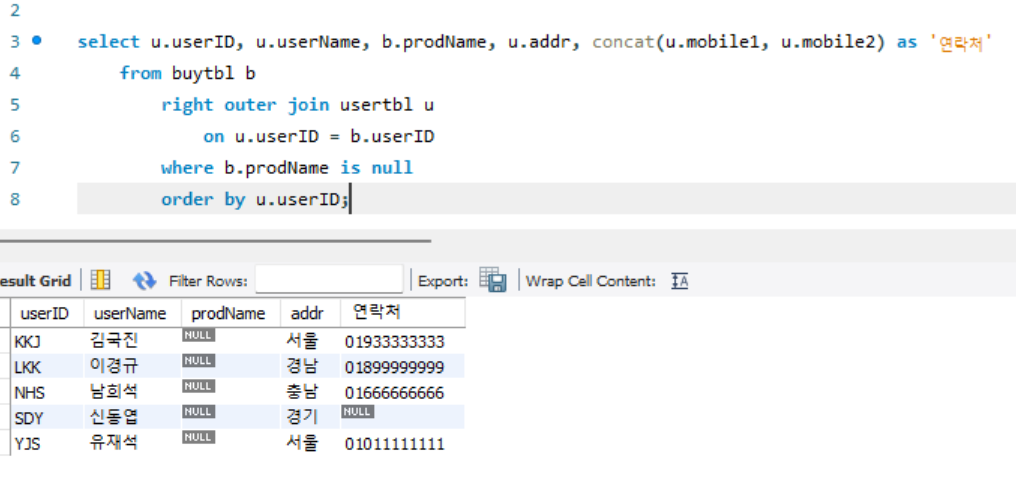
where로 엮어서 반대 성향 찾기를 할 수 있다
use schooldb;

select *
	from student s
		left join enroll e
			on e.student_id = s.student_id
		where e.enroll_id is null;
outer 조인의 경우 찾는 중요 내용 테이블을 앞으로 돌려야 원하는 데이터를 찾을 수 있다
'공부 > 데이터베이스' 카테고리의 다른 글
| 데이터베이스 (2025 11 17) (0) | 2025.11.17 |
|---|---|
| 데이터베이스 (2025 11 12) (1) | 2025.11.12 |
| 12. 데이터베이스 응용 기술 / 총 정리 (0) | 2025.09.16 |
| 12. 데이터베이스 응용 기술 / 02 객체관계 데이터베이스 / 03 분산 데이터베이스 시스템 (0) | 2025.09.16 |
| 12. 데이터베이스 응용 기술 / 01 객체지향 데이터베이스 (1) | 2025.09.16 |